
Domestic IT firms are continuing their hiring juggernaut, but it is their bench strength or reserve employees that is growing at a higher rate than the overall pace of recruitments.

UltraTech Cement was the biggest gainer in the Sensex chart, climbing 3.13 per cent, followed by Kotak Mahindra Bank, Tata Motors, Axis Bank, Maruti, Bajaj Finserv, Bajaj Finance and Mahindra & Mahindra. In contrast, Infosys, Tech Mahindra, Tata Consultancy Services, Wipro, Bharti Airtel, HCL Technologies, ICICI Bank and Nestle were among the laggards.
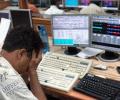
Benchmark indices Sensex and Nifty slid for a seventh straight session on Monday, logging their longest losing run in the past five months, following a bearish trend in global markets amid concerns over aggressive rate hikes by developed economies. Fresh foreign fund outflows and losses in IT, auto and oil stocks also dented investor sentiments. The BSE Sensex declined by 175.58 points or 0.30 per cent to close at 59,288.35 with 17 of its shares posting losses.

Equity indices failed to hold on to morning gains on Tuesday, with the Sensex falling 236 points amid a sell-off in IT stocks and weak trends from global markets. The 30-share BSE benchmark opened higher but could not carry forward the momentum and declined 236 points or 0.43 per cent to settle at 54,052.61. During the day, it hit a low of 53,886.28 and a high of 54,524.37. The broader NSE Nifty dropped 89.55 points or 0.55 per cent to end at 16,125.15.
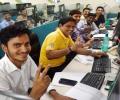
Benchmark BSE Sensex rallied nearly 630 points while Nifty closed above the 16,500 mark on Wednesday after sharp gains in IT and energy shares amid positive global market trends. Buying in index majors Reliance Industries, Infosys and Tata Consultancy Services and FII inflows bolstered the sentiment. Shares of firms related to oil exploration and refineries were in heavy demand, with Reliance Industries rallying 2.47 per cent and ONGC by 4 per cent, as the government slashed windfall tax on petrol, diesel, jet fuel and crude oil.

Among the Sensex firms, Tech Mahindra, Wipro, Infosys, Tata Consultancy Services, HCL Technologies, Larsen & Toubro, ITC, Sun Pharma, NTPC and Titan were the major gainers. Nestle, Axis Bank, Tata Motors, ICICI Bank, HDFC Bank and Bharti Airtel were the laggards.
Infosys, Wipro, Satyam and HCL Technologies form the top five software and service exporters.

The early bird results for the January-March 2022 quarter (Q4FY22) hint at a slowdown in corporate sector growth in the upcoming quarters. The combined net sales of the 81 early bird companies in the Business Standard sample were up 15.1 per cent year-on-year in Q4FY22; this was less than the 15.9 per cent YoY jump reported in Q3FY22. The slowdown could be much stronger for the domestic market-focused companies, including those in the banking, finance, and insurance (BFSI) space.
Spend on IT in US is expected to increase by 6.1 per cent in 2014.
HCL Technologies and Infosys should benefit more than TCS and Wipro

managers said the weaker rupee, which has driven up shares of technology companies, has helped the fund fetch better returns.
The country's IT software and services exports from the top-10 firms crossed $15 billion to touch Rs 68,236 crore (Rs 682.36 billion) in 2006-07.

Investors' wealth fell by Rs 2.39 lakh crore on Monday in line with a weak trend in the global equity markets. The BSE Sensex tanked 861.25 points or 1.46 per cent to settle at 57,972.62. During the day, it tumbled 1,466.4 points or 2.49 per cent to 57,367.47.

Top gainers from the Sensex pack are Infosys, Cipla, NTPC, ITC and Lupin
Chennai's Great Lakes Institute of management (GLIM) has equipped its students with some knowledge of Mandarin, Chinese history and culture.
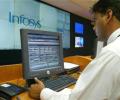
The Street is especially looking forward to the management commentary to get a sense of its new direction

The issue arose after TCS dismissed hundreds of employees in January 2015, leading to the formation of the IT Employees Wing supported by the NDLF.

Among the Sensex firms, Tata Motors jumped over 3 per cent. Tech Mahindra, Infosys, HCL Technologies, Axis Bank, Mahindra & Mahindra, ICICI Bank, UltraTech Cement and Kotak Mahindra Bank were the other major gainers. NTPC, Asian Paints, Titan and Power Grid were among the laggards.

Infosys, however, feels the high level of cash is an important tool to weather tough times.

Reliance Industries Ltd, the country's largest company by revenues, profits and market value, has topped Indian corporate in the World's Best Employers rankings 2021 published by Forbes. Reliance was placed at 52 in the overall ranking of 750 global corporates likes Phillips, Sanofi, Pfizer and Intel. Other Indian names in the top 100 rankings were ICICI Bank at 65, HDFC Bank at 77 and HCL Technologies at 90, according to the Forbes ranking.
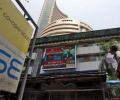
Equity benchmark indices Sensex and Nifty buckled under selling pressure after a nine-session rally on Monday, as massive sell-off in IT, tech and telecom counters unnerved investors.

Benchmark equity indices Sensex and Nifty ticked higher for the ninth straight session on Thursday, buoyed by fag-end buying in banking, financial and realty stocks amid encouraging domestic retail inflation data. Weak trends in IT counters and fall in the overnight US equity markets triggered by fresh concerns over recession, however, put a check on market's uptrend. In a largely subdued session, the 30-share BSE Sensex went up marginally by 38.23 points or 0.06 per cent to settle at 60,431.

Equity benchmarks began the week on a downbeat note on Monday, weighed by heavy selling in market heavyweight Reliance Industries and persisting weakness in global bourses. The rupee plunged to its lifetime low against the US dollar amid unabated foreign fund outflows, underscoring the risk-off sentiment prevailing globally as central banks embark on policy tightening to tame soaring inflation. Slipping for the second straight session, the 30-share BSE Sensex shed 364.91 points or 0.67 per cent to close at 54,470.67.

Equity markets halted their two-day rally on Friday, with the Sensex tumbling 714.53 points amid weak global equities and selling in index majors Infosys, ICICI Bank, HDFC Bank and Reliance Industries. Continuous foreign fund outflows also dented sentiments. The BSE benchmark Sensex tanked 714.53 points or 1.23 per cent to settle at 57,197.15. During the day, it plummeted 776.96 points or 1.34 per cent to 57,134.72. The NSE Nifty also declined 220.65 points or 1.27 per cent to 17,171.95.
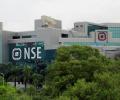
The recent sell-off in IT stocks such as Infosys and Tata Consultancy Services (TCS) has resulted in a sharp decline in the IT sector weighting in the Nifty50 index. The sector's weighting in the index has slipped to a five-year low of 12.2 per cent, down from the 17.7 per cent at the end of March 2022. The top IT companies - TCS, Infosys, Wipro, HCL Technologies, and Tech Mahindra - accounted for 13.6 per cent of the index at the end of March this year.

The 30-share Sensex ended down 339 points at 28,119 and the 50-share Nifty closed 100 points lower at 8,438.

First sequential decline in a decade as 8 of top 15 software firms report drop in manpower

At the end of June, 2016, TCS had a total headcount of 3.62 lakh.

S&P Global Ratings on Thursday said about half of the Indian companies that it rates are getting a boost in their core profitability from rupee depreciation. "Much of our rated India corporate portfolio has sizable US-dollar linked revenue and, therefore, is not exposed to rupee depreciation. "This encompasses entities in the IT, metals, and chemicals sectors. About half of the firms we rate are getting an EBITDA boost from currency weakening," the US-based rating agency said in a report.
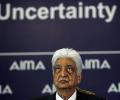
IT stocks have dropped about 3 per cent in the days since the Donald Trump administration took first steps toward visa reform and all of India's highest-profile technology tycoons have seen their net worth eroded. Saritha Rai reports.

Ayan Pramanik and Shivani Shinde Nadhe report on the uncertainties that have dragged down shares of TCS, Tech Mahindra and HCL Technologies.

Revenues, profit margins will be hit in the next one year, but more demand in the longer run.
From the 30-share blue-chip pack, Zomato surged over 7 per cent. Maruti, ITC Hotels, ITC, Mahindra & Mahindra, Asian Paints, Titan and IndusInd Bank were among the biggest gainers. Power Grid, Larsen & Toubro, NTPC, UltraTech Cement, HCL Tech, Tech Mahindra, Infosys and Adani Ports were among the laggards.

Despite the wobble in the markets over the past few weeks, Indian equities remain expensive as measured by several yardsticks. India's market capitalisation-to-GDP ratio, for instance, has touched a multi-year high. The ratio is currently at 116 per cent, based on the FY22E gross domestic product (GDP) number, above its long-term average of 79 per cent.

From the Sensex pack, IndusInd Bank, NTPC, Asian Paints, Hindustan Unilever, JSW Steel, Tech Mahindra, Bajaj Finance, Infosys, Wipro, ICICI Bank, Bajaj Finserv, HDFC Bank and Tata Motors were among the major laggards. HCL Technologies, Power Grid, Titan, Reliance Industries, UltraTech Cement, Tata Steel, State Bank of India and Mahindra & Mahindra were the gainers.

Certain changes in the past two or three years could have a long-term structural impact on the IT services market.
The combined weight of IT companies in the benchmark Nifty 50 index is now at a five-year high of 15 per cent as these companies continue to outperform the broader market.

Stronger rupee likely to take a toll; Infosys results on April 13 to be keenly watched

Among the Sensex firms, Kotak Mahindra Bank, Tata Steel, ITC, ICICI Bank, Bajaj Finserv, Maruti, Mahindra & Mahindra and State Bank of India were the biggest winners. Tata Consultancy Services, Infosys, HCL Technologies, Tech Mahindra, Asian Paints, Wipro and Tata Motors were the biggest laggards.

From the Sensex pack, Larsen & Toubro jumped 4.26 per cent to emerge as the biggest gainer, followed by IndusInd Bank, Tech Mahindra, State Bank of India, HCL Technologies, Power Grid, NTPC, Axis Bank, Kotak Mahindra Bank, HDFC Bank and Wipro. Mahindra & Mahindra, Infosys, UltraTech Cement and Hindustan Unilever were the major laggards.
